The World Bank says Malawi’s debt restructuring launched in mid-2022 has stalled with no comprehensive agreement reached following the lapse of the International Monetary Fund (IMF) programme.
In its April 2026 Africa Economic Update, the Bretton Woods institution said the country’s position remains one of sub-Saharan Africa’s most challenging cases although debt restructuring across the region made tangible progress in 2025.
The bank said the setback came after the lapse of Malawi’s Extended Credit Facility (ECF) with the IMF in May 2025 after running for 18 months without a review.
Reads the update in part: “A growing structural constraint is the rising visibility and influence of non-bonded commercial creditors, particularly regional lenders asserting preferred creditor status, which has emerged as a key impediment to completing restructurings.”
The World Bank said the challenge has appeared concurrently in Ghana, Malawi and Zambia, reflecting a systemic feature of the region’s restructuring landscape rather than isolated, country-specific difficulties.
The bank further observed that the growing influence of non-bonded commercial creditors is complicating restructuring efforts, noting that this challenge has appeared in other countries, pointing to a broader regional trend.
While progress has been made with major bilateral creditors, including China and India, talks with commercial creditors have progressed slowly, according to the Ministry of Finance, Economic Planning and Decentralisation.
Ministry of Finance, Economic Planning and Decentralisation has since announced plans to re-profile domestic debt to ease pressure and create fiscal room, but that progress remains gradual, with Malawi’s case reflecting the persistent gap, according to the World Bank.
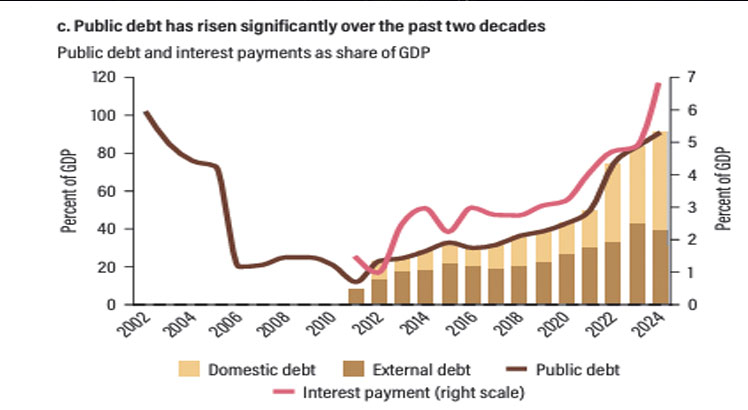
Malawi Government data show that the current public debt stock levels stand at K23.9 trillion, which is 90.9 percent of gross domestic product as of December 2025.
Of this amount, 65 percent is domestic debt, translating to K16 trillion.
In the current fiscal year that ends on March 31 2027, public debt interest is projected at K2.7 trillion, representing 22.9 percent increase from the 2025/26 fiscal year revised figure of K2.2 trillion, largely due to past committed debt.
In an interview on Monday, Scotland-based Malawian economist Velli Nyirongo said without a comprehensive and credible restructuring deal, “Malawi will find it difficult to restore debt sustainability, regain access to new funding, or stabilise the economy”.
He said: “Malawi’s external debt service obligations far exceed its capacity to pay, particularly after years of economic shocks, declining donor support and persistent current account deficits.”
Mzuzu University economics lecturer Christopher Mbukwa said in an interview on Monday that debt restructuring can help to lower interest costs and release resources for essential services.
In the 2026/27 Budget Statement, Minister of Finance, Economic Planning and Decentralisation Joseph Mwanamvekha said Malawi’s path towards managing public debt is constrained by the current debt stock levels.
He, however, said the 2026/27 National Budget estimates were formulated on the basis that, among others, debt restructuring will create fiscal space.
The 2025 Debt Sustainability Analysis by the World Bank classified Malawi as being in debt distress, a situation that makes government struggle to meet financial obligations, leading to high risk of default.
In 2020, the G20 established the Common Framework for Debt Treatment to provide low-income countries such as Malawi with an orderly, coordinated approach to restructuring unsustainable debt.